
GEHA Field at Arrowhead Stadium (Kansas City, Missouri, USA) FIFA World Cup 26 Threat Assessment
Security threat assessment for matches hosted at GEHA Field at Arrowhead Stadium (Kansas City, Missouri, USA) during the FIFA World Cup 26. Threat assessment based on two years of historical crime and unrest data within 1.5 miles of venue and 0.5 miles of nearby transit hub.
1. Overview
- Date Assessment Prepared: November 10, 2025
- Data Coverage Period: September 30, 2023 – September 30, 2025
- Stadium Location: GEHA Field at Arrowhead Stadium
- Transit Hub Location: Blue Ridge Cut Off at Red Coat Lane Southbound
- Host City: Kansas City, Missouri
Methodology Disclaimer This assessment integrates Base Operations quantitative threat data with qualitative intelligence from open sources collected via deep research AI agents. Confidence levels reflect source reliability: High (government/Base Operations verified data), Medium (multiple corroborating sources), Low (single source/extrapolated). AI agents can provide incorrect or misleading information. To ensure up to date accuracy of stadium threat assessment, analyze the latest data in Base Operations.
2. Executive Summary
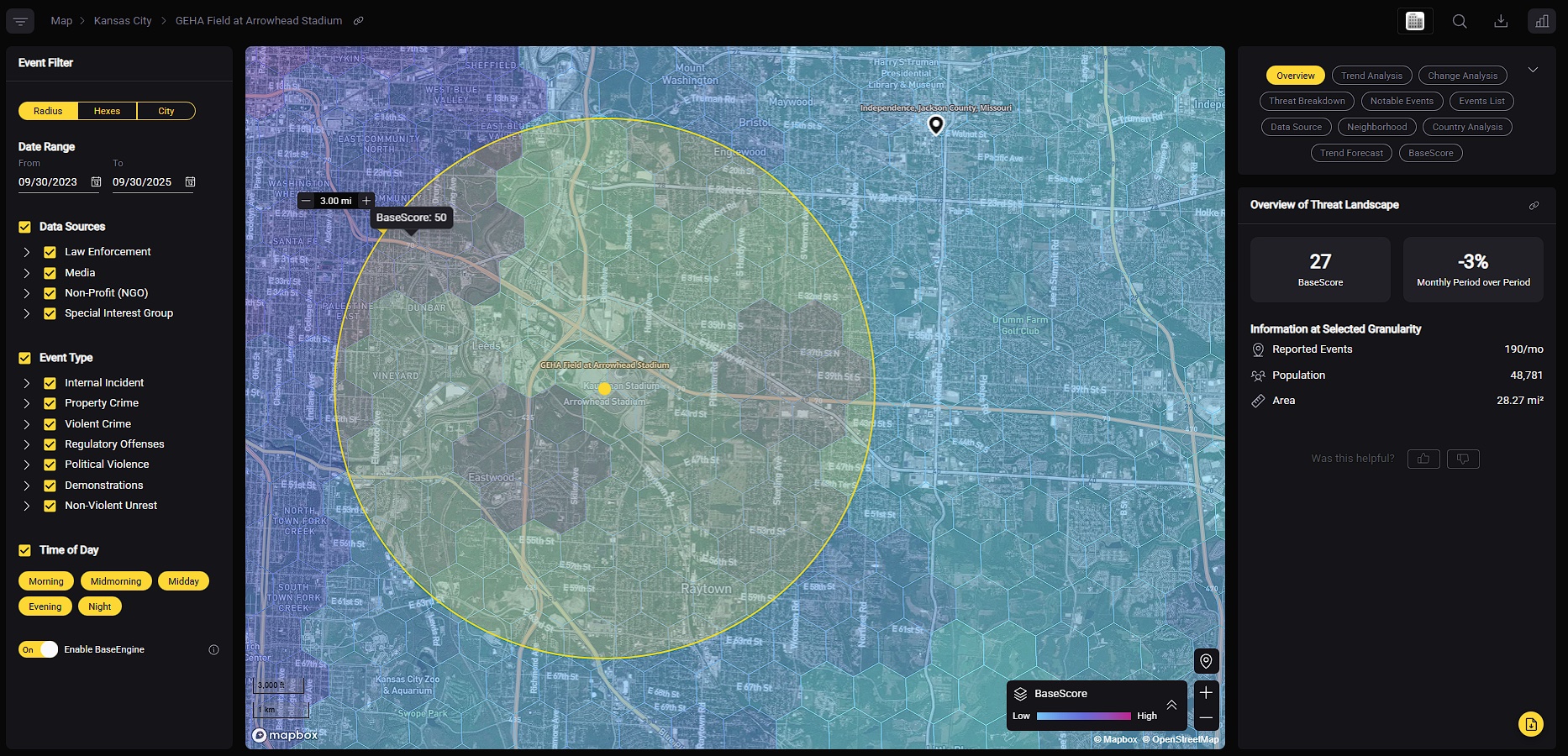
GEHA Field at Arrowhead Stadium presents a Low BaseScore Risk Tier (BaseScore 27) based on validated, standardized threat intelligence from Base Operations. While the historical baseline indicates a manageable security environment, the FIFA World Cup 2026 introduces specific operational complexities that elevate the qualitative risk profile, particularly regarding infrastructure resilience and VIP movement.
Key Findings:
- Property Crime Dominance (High Confidence): Vehicle theft (900 incidents) and theft from vehicles (385 incidents) constitute the primary opportunistic threats within the 3-mile stadium radius. Property crime accounts for 66% of all recorded security events.
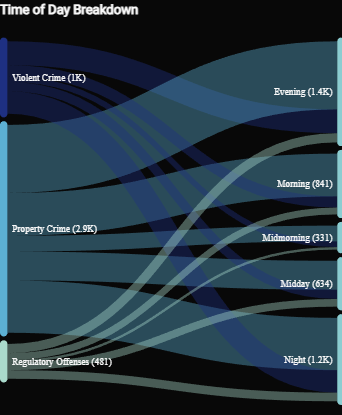
- Temporal Violence Patterns (High Confidence): Violent crime is concentrated during evening hours, with 47% of aggravated (384) and simple assaults (261) occurring between 6:00 PM and midnight. This timeframe directly aligns with anticipated World Cup match schedules.
- Transit Hub Vulnerability (High Confidence): The Blue Ridge Cut Off transit hub holds a Low BaseScore Risk Tier (BaseScore 21). However, it functions as a critical choke point with high threat density; vehicle-related crimes (123 incidents) represent 45% of all activity in this 0.5-mile zone, posing specific risks to executive transport.
- Seasonal Threat Elevation (Medium Confidence): Forecasting indicates crime levels may reach 196 events per month during July 2026, a seasonal peak that coincides with quarter-final matches.
- Infrastructure Stress (High Confidence): Local utility grids have demonstrated vulnerability to summer severe weather, including multi-day outages affecting 50,000+ customers in July 2025.
Strategic Takeaway: While local crime levels are moderate, the convergence of 650,000 visitors, geopolitical tensions, and documented infrastructure fragility requires enhanced protective protocols beyond standard NFL game-day operations.
3. Event Snapshot
- Tournament Dates: June 11 – July 19, 2026.
- Match Count: Six matches (Group Stage through one Quarter-Final).
- Venue Capacity: 76,000 spectators.
- Expected Visitor Volume: 650,000 unique visitors to the Kansas City metro area.
- VIP Attendance: High-profile attendance is expected to include corporate executives, government officials, and diplomatic delegations. Quarter-final matches may attract foreign ministers or heads of state, triggering quasi-diplomatic summit protocols coordinated by the U.S. Secret Service and State Department.
- Historical Significance: Opened in 1972, Arrowhead is the smallest host city venue, presenting challenges in scaling operations from domestic NFL standards to international requirements involving diverse threat actors and language needs.
4. Area & Infrastructure Overview
Geographic Setting
GEHA Field at Arrowhead Stadium is located within the Truman Sports Complex, approximately 15 miles southeast of downtown Kansas City. The venue is isolated, surrounded by extensive surface parking lots with minimal high-rise development. This standalone configuration offers security advantages, such as large perimeter buffer zones and limited sniper vantage points, but complicates access due to constrained public transit and highway-dependent evacuation routes.
Transportation Infrastructure
- Primary Highway: Interstate 70 (I-70) is the main vehicular access route connecting to Kansas City International Airport (MCI), located 21 miles northwest.
- Secondary Routes: Blue Ridge Cut Off, Red Coat Lane, and Stadium Drive serve as final approach roads.
- Public Transit: The Kansas City Area Transportation Authority (KCATA) will deploy 200+ leased shuttle buses to manage spectator load.
- Parking: While stadium lots usually hold 20,000+ vehicles, capacity will be restricted during the tournament.
Critical Utilities
- Power Grid: Entergy serves the metro area. The grid has documented vulnerabilities to severe summer weather.
- Emergency Services: The University of Kansas Health System and Kansas City Fire Department provide response capabilities.
- Law Enforcement: Kansas City Police Department (KCPD) East Patrol Division is located 12 minutes from the venue.
5. Historical Incident Review
Historical analysis of security incidents at Arrowhead Stadium and comparable events highlights persistent vulnerabilities in crowd management and perimeter security.
- Violent Incident (2013): A fatal beating occurred in the stadium parking lot following a mistaken vehicle identity dispute. This incident exposed gaps in surveillance and patrol presence during active play, leading to subsequent lighting and camera upgrades.
- Vehicle Perimeter Breach (2020): During the Super Bowl victory parade, an intoxicated driver breached barriers, requiring tactical intervention by KCPD. This underscored the necessity for hardened perimeter protocols, including concrete barriers and spike strips, which are planned for 2026.
- Recent Crowd Management (2024-2025): Arrests at the venue have increased by 12% recently, driven by public intoxication, assault, and disorderly conduct. Field intrusions remain a recurring disruption.
- Comparable Event Intelligence (Super Bowl LII, 2018): Intelligence from Minneapolis indicated a surge in opportunistic crimes, including wallet theft and counterfeit ticketing scams targeting visitors. Similar tactics are anticipated for 2026, specifically targeting international attendees.
6. Current Threat Landscape
6.1 Crime Trends & Opportunistic Threats
Base Operations Data Analysis (Sept 2023 – Sept 2025)
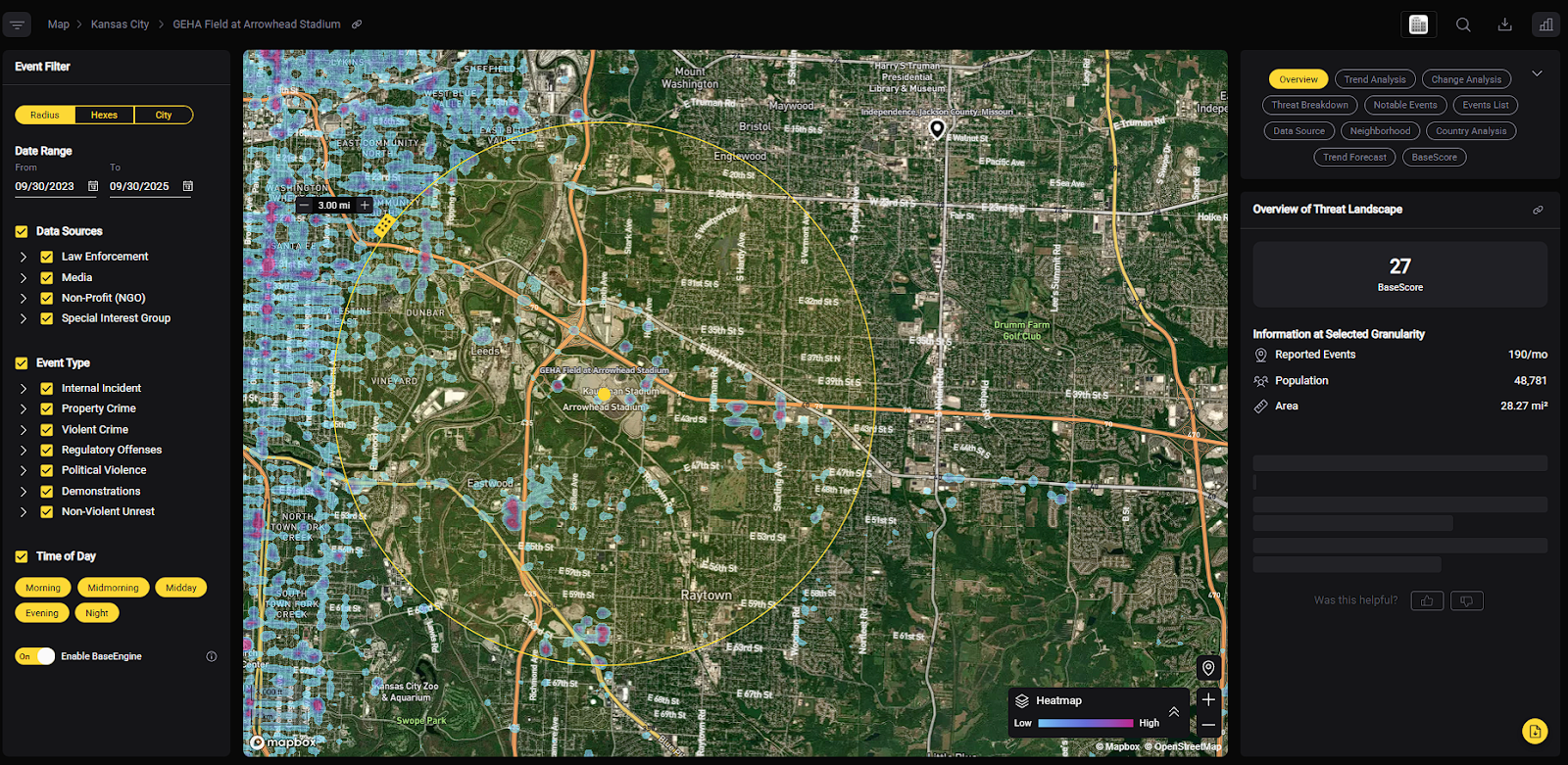
The immediate 3.0-mile radius around GEHA Field recorded 4,429 security events during the reporting period.
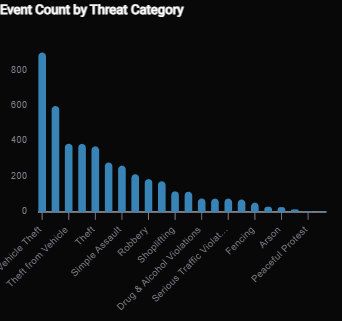
- Vehicle-Related Crime: This is the dominant threat vector. Vehicle theft (900 incidents) and theft from vehicle (385 incidents) combined account for approximately 29% of all security events.
- Violent Crime Distribution: Violent crime (1,002 incidents) comprises 23% of the total.
- Aggravated Assault: 384 incidents.
- Simple Assault: 261 incidents.
- Temporal Analysis: Violent crime shows a distinct correlation with evening hours.
- Evening (6:00 PM – 11:59 PM): 33% of violent crime.
- Night (12:00 AM – 5:59 AM): 31% of violent crime.
- Relevance: 64% of violent crime occurs in the window most utilized for World Cup matches and post-match egress.
Transit Hub Analysis (0.5-mile radius) Despite a lower incident volume due to the smaller area, the Blue Ridge Cut Off transit hub exhibits high threat density. Vehicle-related crimes (54 thefts, 69 break-ins) account for 45% of all events in this zone, confirming it as a high-risk node for spectators utilizing shuttle services or rideshare.
Localized Violence Warning While city-wide crime trends in Kansas City have improved (robberies down 23%), the East Patrol Division jurisdiction encompassing the stadium experienced a 74% increase in homicides (from 27 to 47) between 2024 and late 2025. This localized spike contradicts broader positive trends.
6.2 Terrorism and Extremism
The World Cup is designated a National Special Security Event (NSSE).
- Threat Vectors: Potential actors include ISIS/Al-Qaeda-inspired individuals, domestic violent extremists (DVEs), and state-sponsored disruptors.
- Current Intelligence: As of November 2025, no specific plot against Arrowhead Stadium has been identified. However, the event remains a high-value target for symbolic attacks.
- Tactics: Historical precedents (Munich 1972, Paris 2015) suggest risks ranging from lone-actor attacks to coordinated assaults on soft targets outside the hardened perimeter.
6.3 Activist and Protest Activity
Specific activist groups may view the high-profile nature of the World Cup as a platform for disruption.
- Issues: Potential protest drivers include climate change advocacy and labor rights.
- Operational Impact: While likely non-violent, protests can disrupt transit corridors and stadium access points, complicating logistics for VIP motorcades and general admission.
6.4 Cyber and Information Risks
- Scams: Malicious domains (e.g., "kansascityunitycup2026[.]com") have been identified targeting attendees.
- Infrastructure: New temporary systems, such as those used for shuttle bus dispatch, introduce fresh attack surfaces for cyber exploitation.
- Ticketing: Counterfeit ticket fraud is expected to target international visitors unfamiliar with U.S. digital systems.
7. Threat Actor Profiles
Opportunistic Criminals (High Confidence)
- Motivation: Financial gain.
- Tactics: Vehicle theft, burglary, pickpocketing, and fraud.
- Targeting: Tourists, rental vehicles, unattended property, and hotel rooms.
- Activity: Base Operations data confirms a high frequency of property crime (2,924 incidents over two years), indicating a persistent and highly probable threat to attendees.
Transnational Criminal Organizations (Low Confidence - Direct Targeting)
- Actors: Mexican Cartels.
- Motivation: Drug trafficking and money laundering.
- Assessment: While cartels possess sophisticated capabilities, they generally avoid high-profile attacks on U.S. soil that would invite federal scrutiny. The threat is primarily indirect, related to background criminal activity rather than targeted attacks on the tournament.
Ideological Actors (Medium Confidence)
- Actors: Domestic Violent Extremists (DVEs) and Homegrown Violent Extremists (HVEs).
- Motivation: Ideological grievances or desire for notoriety.
- Assessment: Low probability but high impact. The localized spike in homicides within the East Patrol Division suggests a volatile operating environment that could be exploited by violent actors.
8. Key Takeaways
9.1 Corporate Security Director
Prioritize the following actions to secure executive protection operations:
- Harden Transit Corridors: The Blue Ridge Cut Off transit hub is a choke point with more vehicle crime (BaseScore 21). Avoid this node for executive motorcades. utilize pre-cleared routes and premium parking (Lots E/M) to bypass vulnerable shuttle systems.
- Schedule Defensive Movements: Initiate VIP departures 30 minutes prior to mass egress. This avoids the traffic congestion that prolongs exposure and mitigates risk during the peak window for interpersonal violence (6:00 PM – Midnight).
- Enforce Cyber Hygiene: Mandate VPN use and prohibit public Wi-Fi for all staff. Brief personnel on recognized malicious domains and potential phishing campaigns.
9.2 Security Analyst
Integrate these findings into travel advisories and threat monitors:
- Data-Driven Risk Assessment: Utilize Base Operations data to quantify risks. Cite the 900 vehicle thefts and 385 break-ins to substantiate warnings regarding rental vehicle security.
- Geographic Granularity: Distinguish between the general stadium vicinity (Low Risk, BaseScore 27) and the higher density threat environment of the transit hub. Apply this distinction to route planning.
- Seasonal Awareness: Update risk models to reflect the seasonal elevation in crime. June and July historically see incident levels 18% higher than the annual low, coinciding with the tournament.
- Localized Context: Highlight the specific homicide spike in the East Patrol Division, ensuring that broad, positive city-wide statistics do not obscure the elevated lethal risk in the immediate operational zone.
9. Appendices
Acronyms
- APT: Advanced Persistent Threat
- C-UAS: Counter-Unmanned Aircraft Systems
- DDoS: Distributed Denial of Service
- DHS: Department of Homeland Security
- DVE: Domestic Violent Extremist
- FBI: Federal Bureau of Investigation
- FIFA: Fédération Internationale de Football Association
- HVE: Homegrown Violent Extremist
- IED: Improvised Explosive Device
- IPCC: International Police Cooperation Center
- ISIS: Islamic State of Iraq and Syria
- KCATA: Kansas City Area Transportation Authority
- KCPD: Kansas City Police Department
- MCI: Kansas City International Airport
- NSSE: National Special Security Event
- SLTT: State, Local, Tribal, and Territorial
- TSA: Transportation Security Administration
- UAS: Unmanned Aircraft System
- VBIED: Vehicle-Borne Improvised Explosive Device
- VIP: Very Important Person
Key Contacts
- Emergency: 911
- Kansas City Police Department (KCPD): Non-Emergency Line
- Kansas City Fire Department
- Medical: University of Kansas Health System, Research Medical Center, Saint Luke's Hospital
- Federal Law Enforcement: FBI Kansas City Field Office, DHS/Secret Service (via event coordinators)
- Operations: FIFA World Cup 26 Kansas City Host Committee, GEHA Field at Arrowhead Stadium Operations
Methodology
Base Operations provides validated, standardized, and actionable threat intelligence updated monthly. Data sources include law enforcement incident reports (KCPD, Missouri State Highway Patrol), media monitoring, Natural Language Processing (NLP), and geospatial analysis. The BaseScore is a proprietary algorithm weighting incident severity, frequency, recency, and geographic concentration on a scale of 0-100. This assessment synthesizes this empirical data with strategic intelligence from research reports regarding terrorism, cyber threats, and infrastructure resilience.
Data Limitations
Base Operations data current September 30, 2023 – September 30, 2025. Cyber threats not captured in Base Operations metrics. Private security incidents may be underreported. Historical patterns may not predict novel threat vectors. This assessment represents analysis current as of the Date Assessment Prepared. Threat conditions may evolve rapidly. Continuous monitoring through Base Operations and coordination with law enforcement partners is essential for maintaining situational awareness throughout the tournament period.
10. References
Base Operations Data Sources
- Base Operations Intelligence Platform. "GEHA Field at Arrowhead Stadium Threat Assessment Data." Assessment Period: September 30, 2023 – September 30, 2025. BaseScore: 27. [Proprietary Data - Not Publicly Available]
Base Operations Intelligence Platform. "Blue Ridge Cut Off at Red Coat Lane Southbound Transit Hub Threat Assessment Data." Assessment Period: September 30, 2023 – September 30, 2025. BaseScore: 21. [Proprietary Data - Not Publicly Available]
Base Operations Monthly Crime Trend Forecast. "GEHA Field at Arrowhead Stadium - Event Count Projections November 2025-January 2026." Forecast Date: November 2025. [Proprietary Data] - Base Operations Time of Day Analysis. "Primary Threat Categories by Time Period - GEHA Field at Arrowhead Stadium." Data Period: September 30, 2023 – September 30, 2025. [Proprietary Data]
- Base Operations Threat Category Breakdown. "Event Count by Threat Category - GEHA Field at Arrowhead Stadium." Total Incidents: 4,429. Data Period: September 30, 2023 – September 30, 2025. [Proprietary Data]
- Senate Homeland Security Committee Testimony (Dr. Gina Ligon), November 14, 2023: https://www.hsgac.senate.gov
- Counter Extremism Project, "ISIS Threats During 2018 World Cup," June 28, 2018: https://www.counterextremism.com
- U.S. Department of Justice, "Missouri Man Sentenced for ISIS Material Support," March 4, 2020: https://www.justice.gov
- TIME Magazine, "Kansas City Shooting Suspect White Supremacist," April 13, 2014: https://time.com
- VOA News, "Kansas Bomb Plot Sentences," January 26, 2019: https://www.voanews.com
- Associated Press, "Missouri ISIS Attack Plot Sentence," March 4, 2020: https://apnews.com
- KCUR 89.3 (Peggy Lowe), "Kansas City Police World Cup Plan," August 7, 2025: https://www.kcur.org
- KCTV5 (Gabbi Lumma), "Kansas City Counterterrorism Prep for World Cup," October 28, 2025: https://www.kctv5.com
- Kansas City 2026 Host Committee, "Transportation Planning Update," July 11, 2025: https://kansascityfwc26.com
- ABC News (Deena Zaru), "Native American Advocates Protest Chiefs Name," February 12, 2023: https://abcnews.go.com
- The Guardian, "Climate Protesters Disrupt Sports Events," September 7, 2023: https://www.theguardian.com
- Star Tribune (Libor Jany), "Super Bowl Fraud and Pickpockets," February 6, 2018: https://www.startribune.com
- KMBC News (Chloe Godding), "Kansas City Crime Decreases," November 5, 2025: https://www.kmbc.com
- KMBC News (Matt Flener), "Homeless Camp Near Arrowhead Stadium," July 8, 2025: https://www.kmbc.com
- DarkReading (Robert Lemos), "FIFA World Cup 2026 Cyber Challenges," September 26, 2025: https://www.darkreading.com
- U.S. House Homeland Security Committee, "World Cup Security Preparations Hearing," September 17, 2025: https://homeland.house.gov
- KCPD News Release, "Police Stop Car on Victory Parade Route," February 7, 2020: https://kcpolice.org
- "GEHA_Field-Gemini.docx" - Strategic Threat Assessment: FIFA World Cup 2026 GEHA Field at Arrowhead Stadium. Compiled November 2025. [Internal Research Document]
- Domestic Preparedness, "FIFA, Terrorism, and 2026 World Cup Preparedness": https://domesticpreparedness.com/articles/fifa-terrorism-and-preparedness-for-the-2026-world-cup-in-the-u-s/
- KCUR, "Kansas City Protests Coverage": https://www.kcur.org/tags/protests
- Cyber Press, "Cybercriminals Eye 2026 FIFA World Cup": https://cyberpress.org/2026-fifa-world-cup-cyber-attack/
- NCBRT/Academy Counter-Terrorist Education, "Past World Cup Threats": https://ncbrt.lsu.edu/programs/worldcup/pastthreats.php
- Burns & McDonnell, "Arrowhead Stadium Traffic Study": https://www.burnsmcd.com/projects/arrowhead-stadium-traffic-study
- The Law Firm, "Violations at Kansas City Chiefs/Royals Games": https://www.the-law.com/practice-areas/violations-at-kansas-city-chiefs-royals-games/
- FedScoop, "DHS Counter-Drone Tech Grants for World Cup/Olympics": https://fedscoop.com/radio/with-america-hosting-major-upcoming-global-events-agencies-and-officials-have-been-calling-for-coordinated-efforts-to-more-aggressively-confront-the-risks/
- Kansas City Chiefs, "Premium Seating & Suites Information": https://www.chiefs.com/tickets/premiumseatingandsuites/
- BPU News, "Storm Damage Response July 2025": https://www.wycokck.org/Engage-With-Us/News-articles/BPU-Responds-to-Extensive-Storm-Damage-Restoration-Ongoing-July-2025
- Evergy Newsroom, "Storm Outages July 2024": https://newsroom.evergy.com/2024-7-31-Strong-Storms-Winds-Cause-Outages
- Kansas City Chiefs, "Heat Safety Precautions": https://www.chiefs.com/news/exercise-caution-with-high-temperatures-13530821
- KCPD, "Crime Statistics Dashboard": https://kcpolice.org/crime/crime-statistics/
- Dataminr, "2026 World Cup Security Challenges": https://www.dataminr.com/resources/blog/preparing-for-the-2026-world-cup-security-challenges-and-how-to-tackle-them/
- ISMG, "Cybersecurity Summit Midwest AI Strategies": https://ismg.io/ismgs-cybersecurity-summit-midwest-explores-ai-strategies-to-fortify-defenses/
- FIFA World Cup 26 Kansas City, "Transportation Information": https://kansascityfwc26.com/transportation/
- GEHA Field at Arrowhead Stadium, "A to Z Guide": https://www.gehafieldatarrowhead.com/plan-your-visit/a-to-z-guide
- U.S. Department of Homeland Security. "National Special Security Event Designation - FIFA World Cup 2026." Federal Register Notice, 2024. https://www.dhs.gov
- Federal Bureau of Investigation. "Domestic Terrorism Definitions and Threat Assessment." Congressional Research Service Report R47885, 2023. https://www.congress.gov/crs-product/R47885
- Kansas City Missouri Police Department. "East Patrol Division Crime Statistics 2024-2025." Official KCPD Dashboard. https://kcpolice.org/crime/crime-statistics/
- National Institute of Justice. "Domestic Radicalization and Violent Extremism Research." NIJ Topics & Articles. https://nij.ojp.gov/topics/articles/domestic-radicalization-and-violent-extremism
- ResearchGate. "Friendly or Unfriendly Confines: Impact of Chicago Baseball Stadia on Vicinity Crime Patterns." Journal Publication, 2021. https://www.researchgate.net/publication/352195928
- Queen's University Belfast Human Rights Centre. "FIFA World Cup 2026: Priority Human Rights Issues." Working Report, 2024. https://www.qub.ac.uk/research-centres/human-rights-centre/
- University of South Florida St. Petersburg. "Does the Super Bowl Increase Human Trafficking in Host City?" Research Analysis, 2025. https://www.stpetersburg.usf.edu/news/2025/
- ACAMS Today. "Human Trafficking and Major Sporting Events: Dark Side of Super Bowl." Anti-Money Laundering Publication, 2024. https://www.acamstoday.org
Takeaways
Corporate Security Director
Prioritize the following actions to secure executive protection operations:
- Harden Transit Corridors: The Blue Ridge Cut Off transit hub is a choke point with more vehicle crime (BaseScore 21). Avoid this node for executive motorcades. utilize pre-cleared routes and premium parking (Lots E/M) to bypass vulnerable shuttle systems.
- Schedule Defensive Movements: Initiate VIP departures 30 minutes prior to mass egress. This avoids the traffic congestion that prolongs exposure and mitigates risk during the peak window for interpersonal violence (6:00 PM – Midnight).
- Enforce Cyber Hygiene: Mandate VPN use and prohibit public Wi-Fi for all staff. Brief personnel on recognized malicious domains and potential phishing campaigns.
Security Analyst
Integrate these findings into travel advisories and threat monitors:
- Data-Driven Risk Assessment: Utilize Base Operations data to quantify risks. Cite the 900 vehicle thefts and 385 break-ins to substantiate warnings regarding rental vehicle security.
- Geographic Granularity: Distinguish between the general stadium vicinity (Low Risk, BaseScore 27) and the higher density threat environment of the transit hub. Apply this distinction to route planning.
- Seasonal Awareness: Update risk models to reflect the seasonal elevation in crime. June and July historically see incident levels 18% higher than the annual low, coinciding with the tournament.
- Localized Context: Highlight the specific homicide spike in the East Patrol Division, ensuring that broad, positive city-wide statistics do not obscure the elevated lethal risk in the immediate operational zone.
Enter any address. Get BaseScore, crime trends, threat breakdowns, and actionable intelligence in 90 seconds.